|
Key to the Ospriocerus
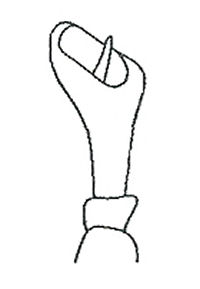
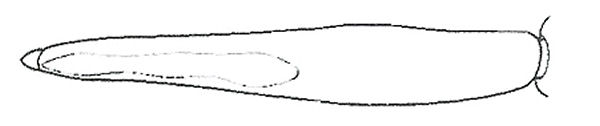
This key was created with the key to the Ospriocerus from the 1968 paper "A Revision of Ospriocerus" by Charles H. Martin. (Thanks to Roy Beckemeyer.) It needed essentially no updating since no updates have been published. Though Eric Fisher's new catalog will eventually change some names. The old names are retained here for now. Characteristics of the antenna were prominent in the major species divisions. These are included as scans from Martin. Scan views are mostly of clefts of the apices of the styli or views of the third antennal segment with style. The male genitalia side view is shown where it was included in Martin's paper.
The species which occur only in Mexico are retained in this genus key because the true distributions of some of these rare insects is likely not fully known.
|
|
1 No style visible above the excision, a cleft below the apex of antennal segment 3 exposing an inset pit with a spine. 18 1’ A visible style above the excision, a pit with a spine on the apex, style from one-fourth to four-fifths as wide as high. 2
2 Bristles on the hind tibia and femora predominantly black. 8 2’ Bristles on the hind tibia and femora predominantly white. 3
3 The third antennal segment either with a rounded angle or without an The third antennal segment near the base of the excision. 5 3’ The third antennal segment angulate near the base of the excision. 4
4 Dorsocentral bristles white; antennal segment 3 short; from a dorsal view the apical half of the upper forceps narrower than base; lateral oral margin tomentose; length 15-19mm. (MX)
alamosensis Martin 1968 4’ Dorsocentral bristles usually black; antennal segment 3 long; from a dorsal view the apical half of the upper forceps nearly as wide as base; lateral oral margin polished black along eyes. Length 19mm. (MX)
evansi Martin 1968
5 Abdominal background color either red or yellow; some segments with black markings. 7 5' Abdominal background color entirely black. 6
6 Bristles on front, vertex and metanotum mostly pale; fore femora reddish with black vittae; length 21-25mm. (AZ NM MX)
arizonensis (Bromley) 1937 6’ Bristles on front, vertex and metanotum mostly black; all femora black and usually stout; length 22-26mm. (TX NM MX)
tenebrosus (Coquillett) 1904
7 Abdomen more or less stout; lower forceps of male genitalia with eight long orange-yellow to whitish close-set curled mesad and anteriorad, opposite tufts often touching; abdomen yellow with varying amounts of black, length 15-21 mm. (Alberta to TX MX)
latipennis (Loew) 1866
7’ Abdomen elongate, extending beyond wings, bristles on lower forceps of male short, length 17-20 mm. (TX NM AZ MX)
longulus (Loew) 1866
8 Third antennal segment strongly angulate; tergites 3-5 of male black, of female usually red sometimes black; length 19-20mm. (MX)
diversus (Williston) 8’ Third antennal segment not strongly angulate 9
9 Thorax black, at most red around humeri 11 9’ Thorax red, reddish-black or yellow; with or without black markings; abdominal tergites 2-4, sometimes 5, white pollinose laterally on the incisures 10
10 Face with polished triangle; thorax brown pollinose, faint median stripe more densely brown pollinose; abdomen either black or red and partially black; length 20-29 mm. (KS TX)
rhadamanthus (Loew) 1866 10’ Face totally tomentose; thorax thinly brown pollinose on black stripes, laterally on reddish background thinly whitish-yellow pollinose; tergite 2 black, tergites 2-7 red dorsally, laterally; length 23mm. (TX)
galadae Martin 1968
11 Hind femora black, red apically and basally, laterally a narrow red longitudinal stripe; length 14-15 mm. (MX)
sinaloensis Martin 1968 11’ Hind femora entirely yellow, blackish-red or black. 12
12 Bristles on metanotum and scutellum black, or bristles both black and white. 15 12’ Bristles on metanotum and scutellum pale. 13
13 Abdomen light cherry red to blackish red; density of gray pollen gradually decreases mesad; male hypandrium broad apically; forelegs yellow with black fasciae ventrally; length 13-18 mm. (TX KS)
pumilus (Coquillett) 1904 13’ Abdomen reddish yellow, thinly pollinose, more densely laterally; forelegs without fasciae. 14
14 Pleura gray pollinose; abdomen with white pollinose spots on posterior corners of tergites 2-4 on most specimens, dense pollen confined to sides; wings broad; length 13-18 mm. (MT to TX)
aeacidinus (Williston) 1886 14’ Pleura yellow pollinose; abdomen without white pollinose spots; dense pollen more extensive on tergite 2; wings narrow; length 15-16 mm. (TX)
ebyi (Bromley) 1937
15 Hair on proboscis and below eyes black 17 15’ Hair on proboscis and below eyes white 16
16 Style of third antennal segment long and expanded apically; mystax white; tergites 2-4 with white pollinose spots caudolaterally on incisures; length 18 mm. (MX)
painterorum Martin 1968 16’ Style of third antennal segment short and not extended apically; mystax black; tergites 2-4 with brownish pollen caudolaterally on incisures; length 22 mm. (ID OR)
vallensis Martin 1968
17 Occipital and collar bristles white, thoracic bristles white laterally, black on metanotal declivity; length 22 mm. (TX MX)
nitens (Coquillett) 1904 17’ Occipital, collar and thoracic bristles black; length 15-16 mm. (MX)
youngi Martin 1968
18 Thorax black. 20 18’ Thorax yellow or red with black markings. 19
19 Face with a polished triangle; mystax and abdomen black; the latter thinly brown pollinose, more densely laterally; length 14-15 mm. (TX)
parksi Bromley 1934 19’ Face tomentose, mystax yellow white to orange-red; abdomen yellow, tergites with anterior black markings, caudolaterally tergites 2-4 densely white pollinose; length 19-24 mm. (MX AZ)
tequilae Martin 1968
20 Abdomen dorsally with ground color mostly red, one or more segments partially or totally black, without pollinose markings caudolaterally; length 12-25 mm. (Western US, Baja and MX)
abdominalis Say 1824 20’ Abdomen totally black. 21
21 Face with a polished triangle; dense long brown hair on the abdomen; length 13 mm. (TX)
villus Martin 1968 21’ Face pollinose; without long brown hair on the abdomen 22
22 Metanotal declivity with short sparse hair; lateral margins of abdomen not pollinose; wings ovate; length 18-22 mm. (AZ NM MX)
minos Osten Sacken 1877 22’ Metanotal declivity with dense hair; lateral margins of abdomen densely brown pollinose; wings narrow; length 16 mm. (CA NV Baja)
brevis Martin 1968
|