|
|
|
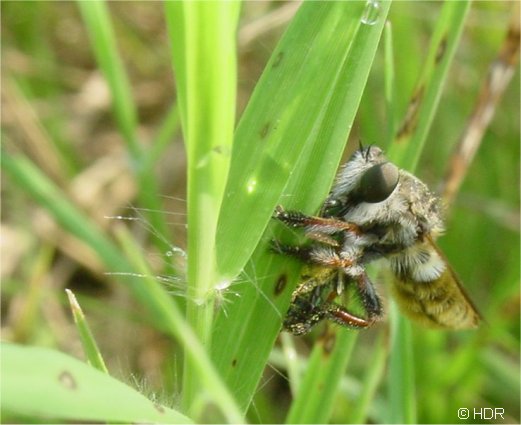
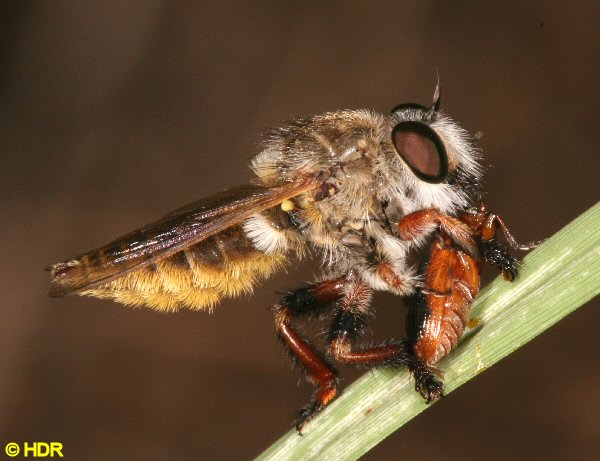
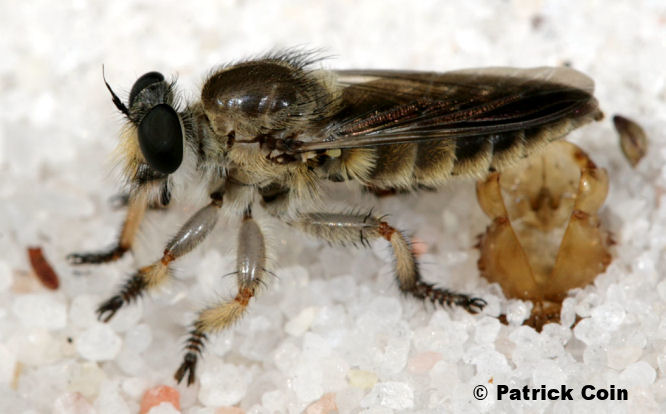
This tiny robber fly is Megaphorus acrus. I discovered a field of them about eight miles from my house adjacent to the Arkansas River. There were literally thousands of them at their peak flight. The low grass hummed with them while they flew and perched, flew and killed, flew and perched, flew and mated. Mixed in with them were many flower bees that were so like the flies that the only way I could tell them apart was to watch them land. If they nectared at flowers they were bees; if they perched on grass blades or stems and cocked back at this angle (shown above) they were robber flies. As with Mallophora, I watched to see if the flies frequently killed their look-alikes and I did not see a single instance of it. This was despite sitting down among them and just letting them work around me by the hundreds making kill after kill. |
|
|
|
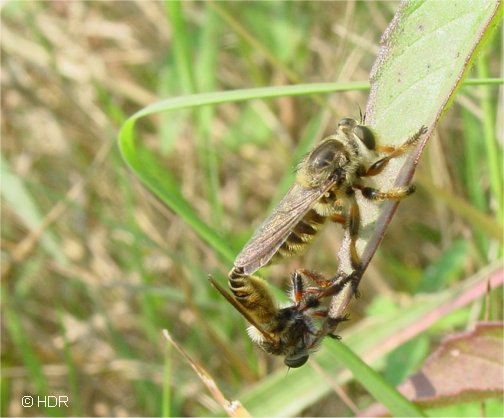
A pair in delectado, or something like that. The smaller male is dangling. I missed an impressive moment when another male flew up to this pair and, without breaking, the attached, possibly joyous but defensive male reared up and threatened the interrupter with a nasty buzz and a look of, well, fly irritation. My finger and shutter were just not quick enough. There is another species of Megaphorus in Arkansas but I have not seen it yet. I look forward to it because previously this Megaphorus field had been just a grassy place poorly attended by birds. Afterwards it was wondrous. Somewhere therein lies the miracle. |